
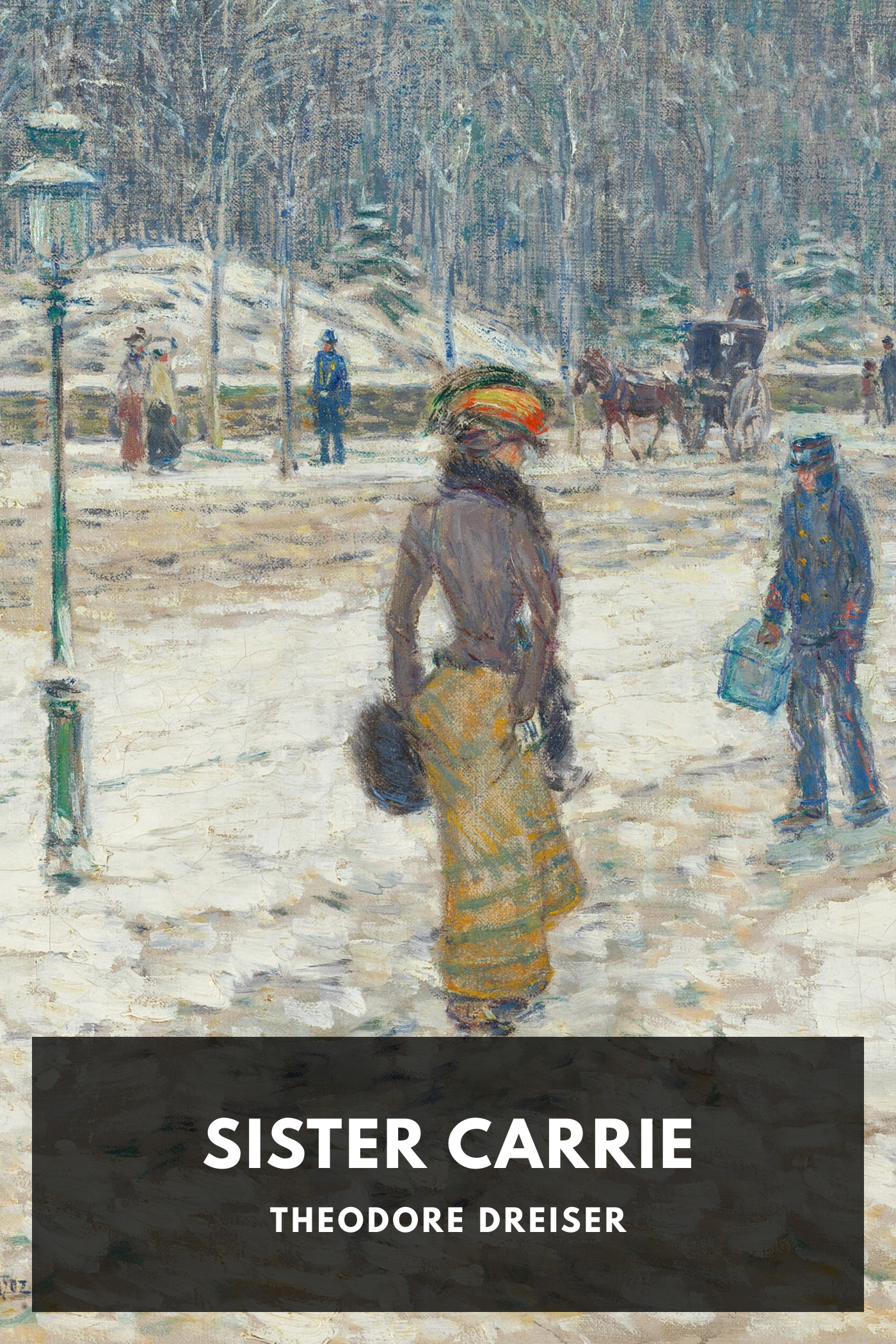
Caroline Meeber, known as Sister Carrie to her family, moves to Chicago at the tender age of eighteen to try to make something of herself. Living with her sister and brother-in-law, she quickly finds that life, and work, are hard in the big city. She soon takes up with a traveling salesman she met on the train into town. Months later her eye is turned by one of the salesman’s acquaintances, George Hurstwood, and vice-versa. A series of events lead Carrie and Hurstwood to New York City, where both struggle to live out the aspirations that brought them there. Theodore Dreiser was one of the earliest naturalist writers, but he wrote Sister Carrie while the United States was still very Victorian in its morals. The book therefore caused a stir from the beginning: Carrie Meeber was clearly, even in the disguised language of the time, a sexually active, unmarried female, who wasn’t made to suffer for her indiscretion to the extent considered necessary at the time. Dreiser’s depiction of rough language merely added to the controversy. The first printing sold only 456 copies in two years; it was to be another five years before Dreiser could convince another publisher to carry the book. Today it’s considered a classic and one of the “greatest of all American urban novels.” The text of Sister Carrie was unchanged until 1981, when the University of Pennsylvania Press published a new version with 36,000 words restored. The edition was not without controversy: the cuts were originally made before the first printing at the suggestion of Dreiser’s wife, or his friend Arthur Henry, and Dreiser had approved all of them. Although the new Pennsylvania Edition, as it is called, made a good case for restoring the changes, it is the 1907 text that remains the most widely available today, and it is that text in this edition. First published 1900.
|
Sign in to join the conversation